

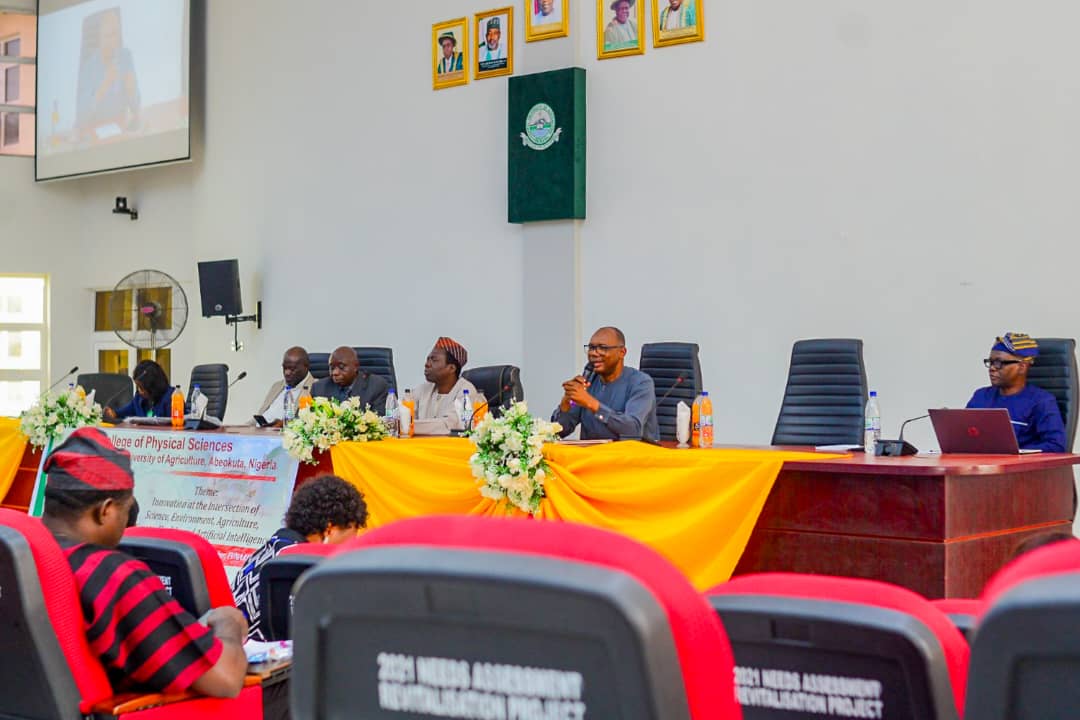
In alignment with the presidential agenda on Reforming the Economy for Sustained Inclusive Growth, the Director General of the National Information Technology Development Agency (NITDA), Kashifu Inuwa, CCIE, has called for a fundamental shift in Nigeria’s education system from a emphasis on academic certificates to one prioritizing practical capabilities, innovation, and practical problem-solving. Speaking through his representative, Dr. Aristotle Onumo, Director of the Special Duties Department, Inuwa delivered the keynote address at the 3rd International Biennial Conference of the College of Physical Sciences (COLPHYS 2026) at the Federal University of Agriculture, Abeokuta (FUNAAB), Ogun State, themed “From Scientific Discovery to National Prosperity: Harnessing Artificial Intelligence and Convergent Innovation to Transform Nigeria.”
Addressing university leaders, researchers, entrepreneurs, and students, the NITDA chief stressed that national prosperity will not depend simply on the volume of academic papers published, but on Nigeria’s capacity to translate research into productive enterprises, enhanced public services, and improved livelihoods. He urged higher institutions to break out of rigid disciplinary silos and embrace cross-sectoral collaboration, pointing out that national progress relies on effectively converting scientific knowledge into practical, commercialized solutions.
Highlighting the role of Artificial Intelligence (AI), Inuwa explained that AI serves to amplify human intellect rather than replace scientific judgment. He noted that emerging technologies enable convergence across agriculture, healthcare, engineering, data science, and environmental studies to tackle complex national issues. However, he cautioned that AI and digital tools must be designed around local realities—such as indigenous languages, affordability, limited connectivity, and data privacy safeguards—to deliver real-world benefits in areas like crop yield optimization, clinical decision support, and flood early-warning systems.
To ensure conference discussions result in practical outcomes, the DG proposed a structured 12-month innovation agenda for FUNAAB’s College of Physical Sciences. Under this timeline, the college is challenged to identify high-impact national problems within the first 90 days, form collaborative research teams and develop prototypes within six months, field-test solutions with industry partners within nine months, and host a research-to-impact showcase in 12 months to demonstrate validated, market-ready solutions.
Reaffirming the agency’s commitment to building a technology-driven economy, Inuwa referenced core NITDA initiatives including the Strategic Roadmap and Action Plan (SRAP 2.0), the National Digital Literacy Framework (NDLF), Digital Literacy for All (DL4ALL), and the 3 Million Technical Talent (3MTT) program. He stressed that realizing these goals requires robust infrastructure—such as high-performance computing, reliable electricity, quality datasets, and strong public-private partnerships—to successfully scale local research into commercial products.
Turning directly to students and faculty, Inuwa advised that while certificates open initial doors, practical capabilities, critical thinking, teamwork, and digital literacy ultimately determine long-term success. He urged universities to redefine their metrics of institutional achievement by becoming engines of enterprise creation, technology transfer, and societal transformation rather than mere institutions for transmitting knowledge and awarding degrees.
Earlier in the event, the Vice-Chancellor of FUNAAB, Professor Olusola Babatunde, represented by the Dean of the College of Environmental Resources Management (COLERM), Professor Olusegun Oguntoke, commended NITDA for championing digital transformation across Nigeria. He concluded by making a formal request to the agency to establish an Information Technology (IT) Hub at FUNAAB to boost the university’s research capacity, expand digital infrastructure, and empower students to build practical technological solutions.
Leave a Reply