

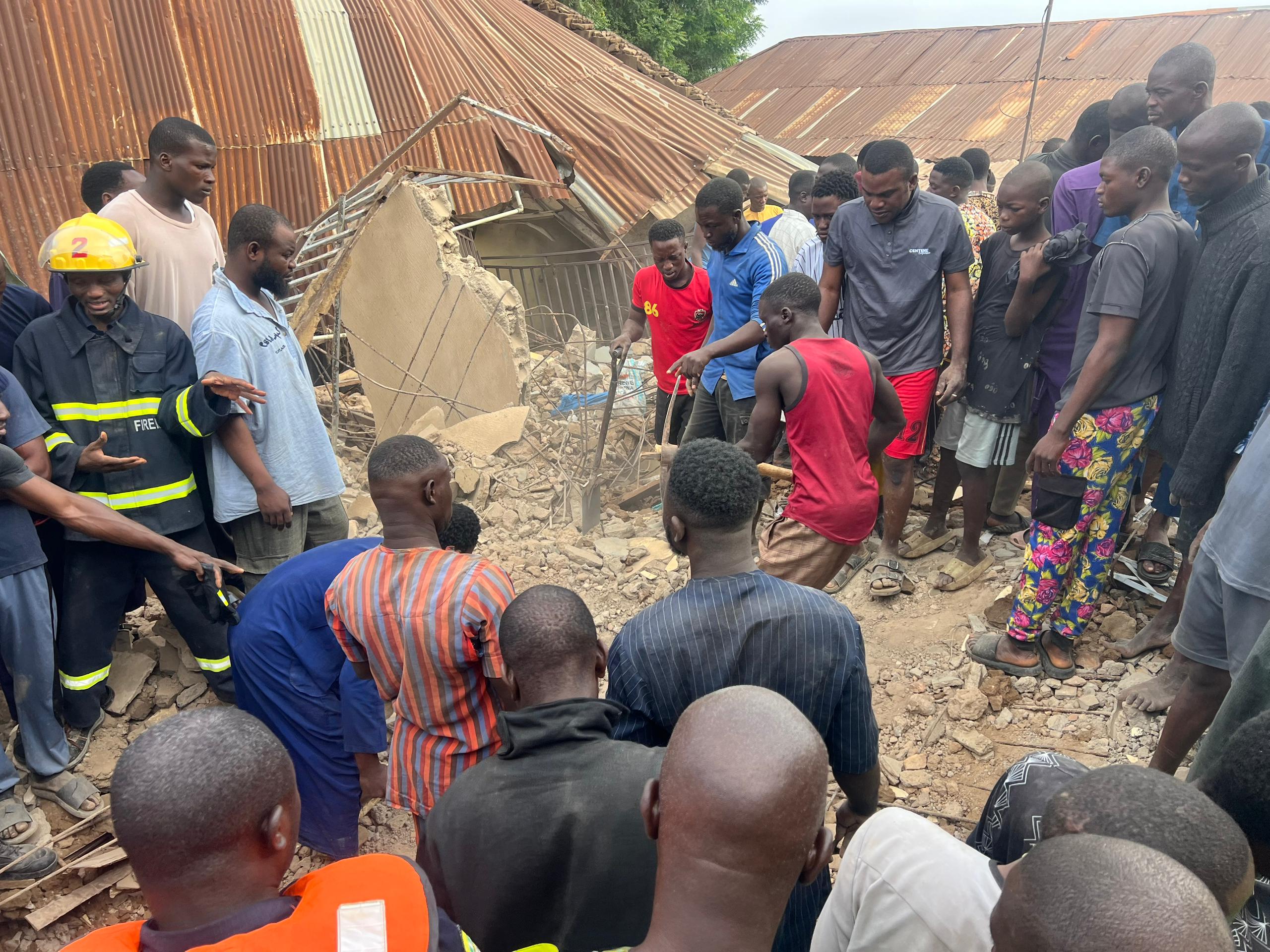
Before dawn had fully broken over Popo Giwa in Ilorin, Kwara State, on Tuesday, the familiar rhythm of the morning call to prayer was suddenly drowned by a deafening crash.
Within seconds, a home that had stood for more than seven decades became a heap of concrete, dust and broken memories, trapping members of a family beneath the rubble and leaving the community to confront another painful question about the safety of ageing buildings across the city.
The collapse occurred shortly after 5am at No. 41 Popo Giwa Street, beside Gogoro Mosque, when the boys’ quarters attached to the main residential building suddenly gave way.
What began as a desperate search for survivors soon became a mourning exercise, as rescuers pulled four people alive from the debris while bodies were also recovered.
But the casualty figures became a source of confusion as the rescue operation unfolded. The Kwara State Fire Service and State Emergency Management Agency initially confirmed four deaths and four survivors, while the family later disclosed that five members had died.
For the family, the tragedy was particularly devastating because one of the survivors, Staff Sergeant Bolakale Kudus of the Nigerian Army, lost his wife and four children in the collapse.
His elder brother and fellow survivor, Alhaji Kudus Olanrewaju, said Bolakale had only recently returned from his duty station in Akure, Ondo State, on medical leave when tragedy struck.
“My junior brother, a staff sergeant in the Nigerian Army, had just come home on medical leave from his station in Akure when the unfortunate incident happened. He lost his wife and four children to the incident,” he said.
Olanrewaju, a former Corporation Secretary of the Kwara State Television Service, was inside the building when the structure collapsed. He recalled that members of the household were preparing for the early morning prayer when the sound of the building giving way shattered the quiet.
“I was contemplating going to the toilet to perform ablution. Thank God I had not moved close to the toilet before I heard a loud sound, gbaa,” he recalled.
“Everybody woke up immediately, but I could not see anything because dust had covered everywhere. I did not know what to do because I did not know what had happened.”
The section that collapsed, he explained, was the boys’ quarters attached to the main building, where his younger brother and members of his family were sleeping.
He said his brother was awake and preparing for ablution when the collapse occurred and was eventually the first person rescued alive.
The relief of seeing him emerge from the rubble, however, was soon overshadowed by the grim reality facing his family.
“I have lost my children. I lost their mother and four of them. Only my brother, who is a staff sergeant in the Nigerian Army, is alive. I have lost five of them,” Olanrewaju said.
He added that three other survivors were receiving treatment in hospital.
The building, according to him, accommodated about 17 people and had been in existence for more than 70 years, making the tragedy not only a family disaster but also a stark reminder of the vulnerability of old residential structures in Ilorin.
As news of the collapse spread, residents, emergency workers and security personnel rushed to the scene.
The Kwara State Fire Service said it received a distress call at about 5am and immediately mobilised personnel and equipment to the location.
“We have recovered four people dead and rescued four people alive,” the Fire Service spokesman, Hassan Adekunle, said.
SEMA Secretary, Magaji Saadudeen, also confirmed that eight people were trapped, adding that those rescued were taken to hospital for treatment.
The rescue operation involved the Fire Service, SEMA, the National Emergency Management Agency, the Nigeria Security and Civil Defence Corps, the Red Cross, police and health officials.
An excavator was later deployed to remove the heavy debris, while ambulances ferried survivors to medical facilities.
For those gathered around the scene, every movement of the excavator carried a mixture of hope and fear. Families waited anxiously for news while rescuers painstakingly searched the remains of a building that had once represented security and belonging.
Kwara State Commissioner of Police, CP Adekimi Ojo, said the collapsed portion was the boys’ quarters of the building and disclosed that occupants of the remaining structure had been evacuated as a precautionary measure.
“For now, the situation is under control. We will examine the remaining building and see how people can be secured. But for now, we have evacuated everybody from the main building,” Ojo said.
The police commissioner urged residents to pay closer attention to warning signs such as leakages and other structural defects, stressing the need to act before such defects develop into disasters.
For AbdulRahman Babatunde Ladan, Chairman of Ilorin West Local Government Area, the incident should serve as a warning to residents living in ageing or questionable structures.
Between six and seven ambulances were deployed to assist with the evacuation, he said, while appealing to residents to place human lives above emotional attachment to buildings.
“Whenever you discover something like this, please escalate it. Get to the point of evacuating yourself and your family members from that building. Life is the priority,” Ladan said.
He also called on developers to use quality materials and engage qualified professionals, noting that proper supervision and compliance with building regulations could help prevent avoidable tragedies.
Representing Governor AbdulRahman AbdulRazaq at the scene, Commissioner for Education and Human Capital Development, Dr Lawal Olohungbebe, described the collapse as unfortunate and expressed the state government’s condolences to the bereaved family.
“The rescue mission began immediately after the collapse and, to the glory of God, some were rescued, but unfortunately, we have to take it as this,” he said.
Olohungbebe also drew attention to the importance of emergency access in residential areas, noting that rescuers were able to reach the collapsed building relatively quickly.
“One of the things that made it very easy for us to rescue the few people we were able to rescue is the access route,” he said.
His comment highlighted a broader urban challenge facing Ilorin and other Nigerian cities, where densely built neighbourhoods and inadequate access routes can complicate emergency response when disasters occur.
As the rescue operation ended, the family’s grief moved from the rubble at Popo Giwa to the Muslim Cemetery at Oko-Olowo.
Five members of the family were eventually laid to rest according to Islamic rites, bringing an end to the immediate search but not the pain left behind.
The Janazah prayer was led by Prof. Abubakr Imam Ali-Agan, a University of Ilorin lecturer and Islamic scholar, who urged the bereaved family and other Muslims to remain steadfast.
“Death is inevitable, and believers must accept whatever Allah has decreed for them,” Ali-Agan said.
The scholar also called for stronger government intervention, public enlightenment and enforcement of building safety standards to prevent similar tragedies.
At the burial, relatives, sympathisers, community members and residents gathered to mourn a mother and four children whose lives ended beneath the roof of a home that had sheltered generations of the family.
Yet, for the surviving members, the tragedy did not end with the burial.
Olanrewaju said the family was struggling to come to terms with the loss while also facing the medical needs of survivors and the reality of losing their home.
He appealed to the Kwara State Government, individuals and other well-meaning Nigerians to assist the family, particularly with medical expenses.
The family was also yet to formally inform the deceased woman’s relatives in Abeokuta, Ogun State, about the death of their daughter and four grandchildren, he said.
“The building is gone,” Olanrewaju lamented.
Those three words perhaps best captured the scale of the family’s loss: a home of more than 70 years gone, five lives lost and survivors left to rebuild from the ruins.
Beyond Popo Giwa, however, the collapse has raised a question that cannot be buried with the victims: how many other ageing or structurally compromised buildings are still occupied across Ilorin?
The tragedy has once again exposed the consequences that can arise when structural defects, ageing buildings, construction standards and safety regulations are not given the attention they deserve.
For residents, the message from Popo Giwa is painfully clear. Cracks, leakages, unusual sounds and other signs of structural distress should never be dismissed.
For authorities, the collapse presents another opportunity to intensify inspection of old buildings, enforce building regulations, ensure compliance with approved construction standards and improve emergency access in densely populated communities.
The debris at Popo Giwa may eventually be cleared, but the memory of a soldier who survived only to lose his wife and four children will remain a painful reminder of what happens when a home ceases to be safe.
A house may carry the history of a family for 70 years, but without structural safety, history alone cannot keep its walls standing.
Leave a Reply