

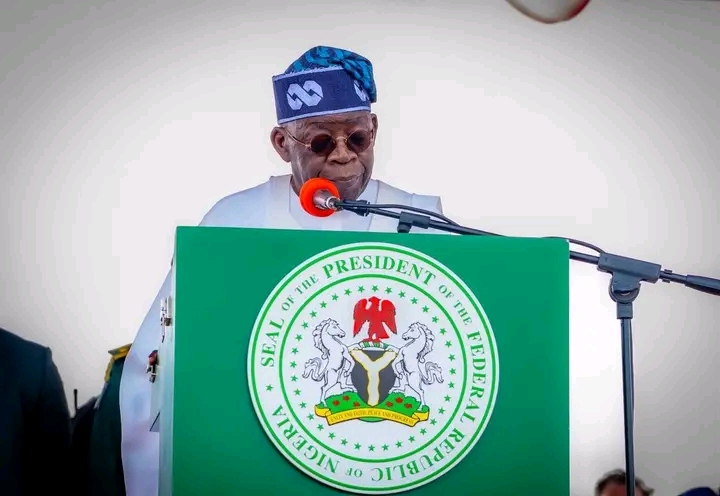
President Bola Ahmed Tinubu has declared that while the heroes of the June 12 struggle secured democracy for Nigeria, the responsibility of the present generation is to translate that democratic freedom into economic prosperity and improved living standards for citizens.
In his Democracy Day address on Friday, marking 27 years of uninterrupted civilian rule, Tinubu paid tribute to pro-democracy activists and national heroes whose sacrifices paved the way for the democratic system Nigeria enjoys today, while urging Nigerians to remain united in building a prosperous nation.
The President said democracy must go beyond periodic elections and be reflected in tangible improvements in the lives of citizens through job creation, food security, economic opportunities and better governance.
“June 12, 1993, revealed the possibility of a true Nigerian nation. The heroes of June 12 secured political freedom. Our challenge is to secure economic freedom,” Tinubu said.
“Democracy must be felt in the quality of people’s lives—in opportunities for youth, in prosperous farmers, successful entrepreneurs, and the dignity of our workers.”
Reflecting on the nation’s democratic journey since 1999, Tinubu noted that Nigeria had successfully sustained civilian governance through elections, peaceful transfers of power and constitutional means of resolving political disputes.
“Our democracy is not perfect, but it is ours, and we must continue to defend and strengthen it,” he stated.
The President also called on stakeholders to ensure peaceful and credible governorship elections in Ekiti and Osun states, stressing that public confidence in the electoral process remains critical to the survival of democracy.
“I urge INEC, security agencies, and all parties to ensure these polls are peaceful and credible. Democracy fails when citizens doubt the process,” he said.
Addressing security challenges, Tinubu acknowledged concerns over the recent abduction of schoolchildren in Oyo and Borno states but assured Nigerians that his administration remained committed to protecting lives and property.
According to him, the Federal Government has intensified efforts against terrorism and banditry, approved the recruitment of over 50,000 police officers and allocated N5.41 trillion to defence and security in the 2026 budget.
He disclosed that terror-related deaths had dropped significantly, while thousands of terrorists had been neutralised and over 124,000 fighters and their dependants had surrendered through Operation Safe Corridor since 2023.
“To bandits, kidnappers, and sponsors of terror: Surrender or face the full force of the Nigerian State. These windows of surrender will not remain open forever,” Tinubu warned.
On the economy, the President defended ongoing reforms, arguing that they were necessary to rescue the nation from fiscal distress and restore investor confidence.
He said revenues accruing to the federation had increased, transparency in public finance had improved and investments across key sectors, including agriculture, manufacturing, technology, mining and energy, were on the rise.
Tinubu also highlighted reforms in the power sector, including the implementation of the Electricity Act, efforts to reduce the metering deficit and investments in rural electrification projects.
“Electricity is a democratic dividend we owe every Nigerian. We intend to deliver it,” he declared.
Despite signs of economic recovery, the President admitted that many Nigerians were still experiencing hardship and assured citizens that government policies were focused on reducing inflation, boosting food production and improving living standards.
“We are moving from uncertainty to stability. The next phase is about accelerating growth and ensuring the benefits are felt in every home, every community, and every region,” he said.
“Democracy must be felt in the pocket.”
Tinubu further reiterated his administration’s commitment to local government autonomy, describing grassroots governance as vital to national development and security.
He maintained that strengthening local councils would ensure that governance and development reached all communities across the country.
“Every generation has a defining responsibility. The generation of our founding fathers secured independence—the generation of June 12 secured democracy. Our generation must secure prosperity,” the President said.
As part of activities marking Democracy Day, Tinubu announced the renaming of the Institute of Petroleum Studies in Kaduna after the late General Shehu Musa Yar’Adua and unveiled a list of democracy activists, journalists, politicians and military officers who would receive national honours for their roles in the struggle against military rule.
The President concluded by urging Nigerians to reject division and remain hopeful about the country’s future.
“The road ahead is steep. But June 12 reminds us: Nigerians do not break. We bend, we bleed, but we do not break,” he said.
“Let us build a Nigeria united by a common purpose, strengthened by diversity, where justice is accessible, liberty is secure, and opportunity is abundant.”
Leave a Reply