

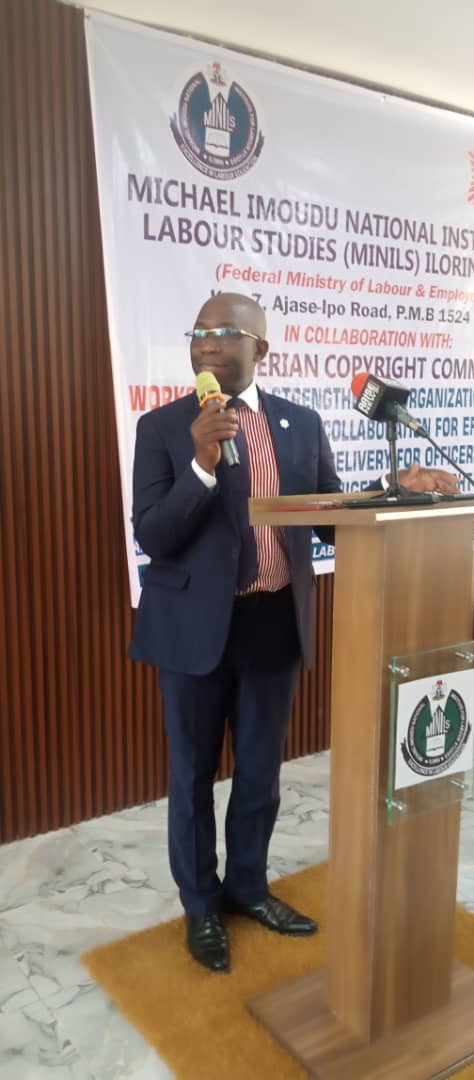
The Nigerian Copyright Commission (NCC), in partnership with the Michael Imoudu National Institute for Labour Studies (MINILS), has trained more than 100 senior officers on improving regulatory efficiency and strengthening service delivery in a rapidly changing digital environment.
The five-day workshop held in Ilorin was designed to equip participants with modern tools for copyright administration, enforcement strategies and institutional performance in the face of growing online content misuse.
Director-General of the NCC, Dr John Asein, who declared the programme open, said many Nigerians still operate under the misconception that digital content is freely available for use without permission, a trend he described as damaging to the creative industry.
According to him, key users such as broadcasters, hotels and other commercial platforms often neglect their obligation to comply with copyright payment requirements.
“Many Nigerians wrongly assume that online content is free to use, while major users such as broadcasters and hotels often fail to comply with payment obligations,” he said.
Asein noted that recent legal reforms now empower the commission to resolve some copyright offences through administrative fines, a move he said would reduce delays associated with prolonged court processes. However, he stressed that weak public awareness remains a major challenge in the sector.
He said the commission was entering a new phase of operations, driven by reforms that have helped it adjust to the global transition from analogue systems to digital platforms, adding that outcomes so far have exceeded expectations.
The NCC boss also urged rights holders to remain committed to the fight against intellectual property theft, warning that piracy is largely sustained by consumer behaviour.
He cautioned that unchecked consumption of pirated materials poses a serious threat to Nigeria’s creative future, especially among young people who form a large part of the digital audience.
Asein further explained that collaboration with MINILS was part of broader efforts to strengthen institutional partnerships and address emerging issues around digital labour and regulatory compliance.
He commended the media for its role in promoting awareness of copyright issues but called for stronger engagement, noting that journalists and media organisations are also rights holders who must be protected.
On inclusivity, he said the new copyright framework now provides improved safeguards for persons with disabilities, reflecting Nigeria’s commitment to expanding access and protection within the creative ecosystem.
Addressing the participants, Asein encouraged them to see their progression to higher responsibilities as a call to greater service delivery and accountability.
“In life, there will always be areas of strength and areas of weakness, but if you bring them together, you can synergise and build a stronger institution,” he said.
He urged them to remain focused despite workplace distractions.
“I urge you to put away all worries about where your colleagues are from. Don’t be overstressed by daily inconveniences. You are here for a purpose,” he added.
He assured that the commission would also improve internal systems to support staff performance, saying the goal was to achieve the broader national vision of renewed hope.
“The one thing I can assure you is that just as we are asking you to do more, we will also do more to make it easier for you to deliver and to ensure that the renewed hope we are all part of is realised in our time,” he said.
Declaring the workshop open, the Minister of Labour and Employment, Muhammad Maigari, represented by the Kwara State Controller, Mr Michael Orodiran, commended the NCC for investing in staff capacity development.
He urged participants to take full advantage of the training to improve their professional competence and contribute more effectively to national development.
Also speaking, the Director-General of MINILS, Comrade Issa Aremu, represented by Dr Michael Raji of the Trade Union Education Department, welcomed participants and described the turnout as impressive.
He said the high level of participation reflected strong interest in professional development within the commission.
Aremu noted that the programme was structured to promote innovation and practical thinking rather than routine lectures.
“Achieving new results requires adopting new approaches. Facilitators will engage participants interactively rather than through conventional lectures,” he said.
He advised participants to apply the knowledge gained in their daily responsibilities and consistently uphold professional ethics.
Some participants expressed optimism about the impact of the training.
Mrs Kehinde Adeshina said she attended with high expectations, noting that she hoped to acquire new skills that would improve her efficiency at work.
“I am here to learn and gain valuable experience that will help me perform better in my duties,” she said.
Another participant, Mr Amos Abutu, described the programme as timely and commendable, praising the NCC leadership for prioritising staff development.
He said the training would likely enhance productivity and improve service delivery across the commission.
Abutu added that such opportunities were rare and encouraged colleagues to make the most of the knowledge gained for career growth and institutional advancement.
Leave a Reply