

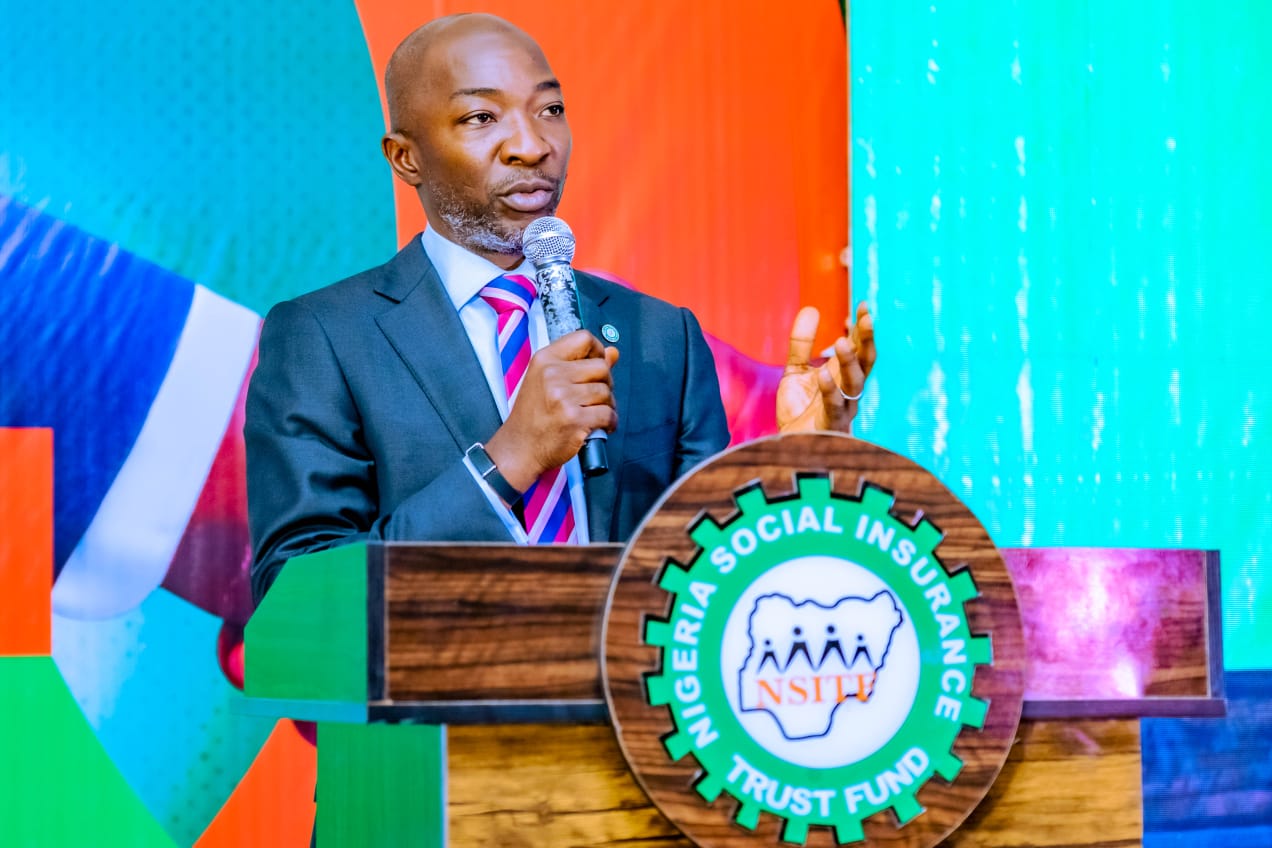
The Nigeria Social Insurance Trust Fund (NSITF) has called on the Nigerian Bar Association (NBA) to lead the push to expand the legal boundaries of workplace protection and social security in Nigeria, saying the law must now cover informal sector and platform workers, not just those in formal employment.
Managing Director/Chief Executive of NSITF, Mr Oluwaseun Faleye, made this assertion at the 66th Annual General Conference of the NBA in Port Harcourt, Rivers State.
Speaking on the theme “Beyond limits: Expanding the legal frontiers of workplace protection and social security beyond limits in Nigeria”, the MD noted that social security, as defined by the International Labour Organisation, is “a foundation for human dignity and resilience” and the protection a society provides to ensure access to healthcare and income security in cases of old age, unemployment, sickness, injury, maternity, or loss of a breadwinner”.
Represented by the General Manager, Abuja Region of the Fund, Mrs. Bridget Ashang, Faleye emphasized that “Social security is not charity. It is social justice,” adding that “ECS exists to ensure that in Nigeria, no worker falls alone.”
NSITF administers the Employees’ Compensation Scheme (ECS) under the Employees’ Compensation Act 2010.
The scheme provides employment injury benefits to workers in both public and private sectors, excluding only officers of the Armed Forces. Contributions are paid solely by employers, and deductions from employees are prohibited.
According to the NSITF MD, the ECS reduces employer liability, supports worker recovery, ensures income continuity, and protects productivity which in turn improves GDP, adding that the Fund also promotes safer workplaces through improved occupational health and safety standards.
He noted that while the ILO’s Social Security Convention No. 102 outlines nine branches of social security — medical care, sickness, unemployment, old age, employment injury, family, maternity, invalidity and survivors’ benefits, Nigeria’s current legal framework still largely limits protection to the formal sector.
To bridge the gap, the NSITF boss outlined six actions for the NBA including raising awareness and building knowledge around workplace protection and social security, assuming advocacy and advisory roles, including corporate audits and test-case litigation to expand the definitions of “employee,” “employer,” and “workplace”, while amending existing labour laws to capture the evolving labour ecosystem, including the informal sector, gig and platform workers amongst others.
He also urged exploration of platform liability, facilitation of ratification and domestication of relevant ILO conventions to set minimum benchmarks and build trust within the labour ecosystem, ensuring consciousness in drafting laws establishing organizations so that no one is excluded and leading by example through self-audits and compliance by law firms and the NBA itself.
According to him, ratifying ILO standards provides a clear legal framework, while strong social deterrence is needed to discourage non-compliance.
“Legal frontiers should be expanded from protecting only ‘formal sector’ to ‘ALL,’” he stated, stressing that “When a lawyer speaks, everyone usually listens.”
Calling for cooperation from the NBA, Faleye reminded the lawyers that social security honours the dignity of work. “Social security is how we honour that sweat. It is how we say: Your work has dignity and your life has value,” he stated.
“Without the law, the Fund is silent. Without the Fund, the law is empty. Together, we can write a new Social contract for Nigerian workers.”
The NSITF helmsman warned that failure to expand the legal frontiers facilitates exclusion, and urged the NBA to use the law as an instrument of social change in line with its own mission.
The NSITF’s vision is to be the leading social security institution in Africa, setting the agenda for change, social policy, economic empowerment and poverty alleviation in Nigeria.
Delegates at the conference are expected to debate labour reforms during the week-long NBA-AGC, which drew thousands of lawyers to Port Harcourt.
Leave a Reply