

Media professionals in Kwara State have been urged to strengthen their fact-checking culture and deploy artificial intelligence as a support tool rather than a substitute for professional judgment, especially as political activities begin to gather momentum ahead of the 2027 general elections.
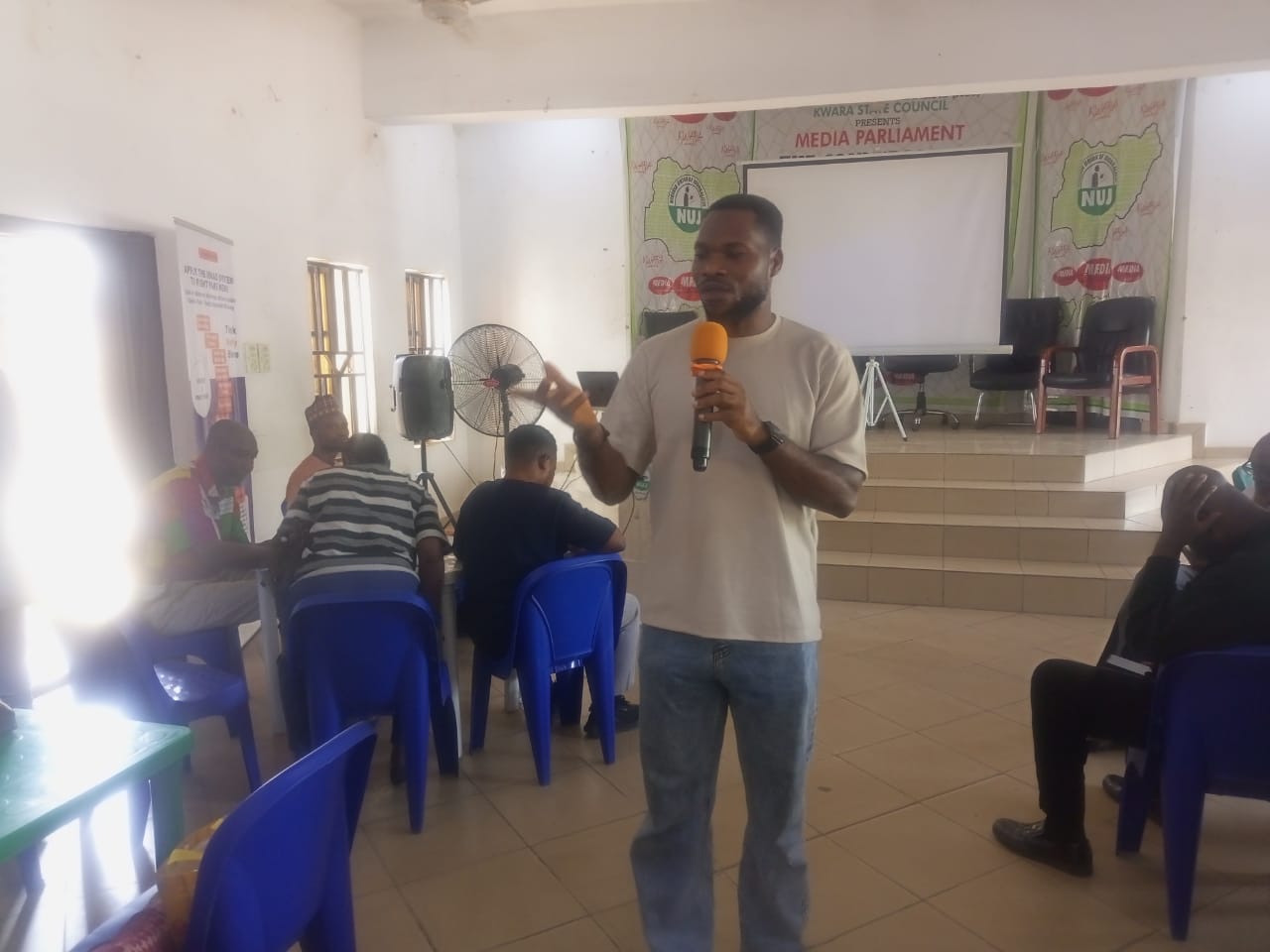
The call was made in Ilorin during a workshop titled Artificial Intelligence (AI): Is Journalism on Trial?, organised by the Nigeria Union of Journalists (NUJ), Kwara State Council, in collaboration with E-SANAD Academy.
Delivering a lecture at the event, resource person Kehinde Kamaldeen warned journalists against total dependence on AI-generated responses, describing such practice as dangerous to the credibility of the profession.
“It is not encouraging for a journalist to depend completely on AI-provided answers,” he said, stressing the need for reporters to clearly define their tasks when using AI tools. According to him, journalists must provide clarity, context, constraints and proper structure when engaging AI in order to achieve meaningful results.
Kamaldeen emphasised that no report should be published without thorough verification. “Before publishing any report, there is a need to fact-check the contents to ensure credibility,” he advised, noting however that journalists who understand how to use AI effectively can work faster and improve productivity.
Also speaking, the Chief Executive Officer of ESANAD Consult Limited, Mr Ganiyu Yusuf Opeyemi, urged journalists to embrace AI as an assistant while maintaining strict human oversight to safeguard public trust.
His firm, a technology-driven organisation focused on fact-checking, media literacy and information governance, he explained, was born out of a research project that examined news transmission systems and reporting patterns in selected mainstream newspapers.
“We looked at how we can use proper checking of modern information to solve contemporary problems,” he said. “Today, we have trained students, organisations and even agencies, and we are working with government institutions, including ministries in charge of education and human capital development.”
Opeyemi warned that artificial intelligence tools are prone to errors, often described as “hallucinations,” where the system introduces information that was never requested.
“When you use AI to generate content, it may bring in extra information you did not ask for. That is what we call hallucination,” he explained. “When hallucination happens in journalism, you have to be very careful. That is where human oversight comes in.”
He maintained that only seasoned professionals can effectively manage AI outputs. “AI should be your assistant. It is not to dominate you. Only the person who understands journalism very well can use AI effectively. If AI makes a mistake, an experienced journalist will know. But a beginner may assume everything it produces is correct.”
According to him, AI tools rely on patterns from existing online data and cannot independently verify unfolding events or provide on-the-ground human insight.
“AI will go all over the internet, look at patterns and predict outputs. But imagine something is happening here now. Can AI accurately tell you how many people are outside or give you human insight? That is the work of a journalist,” he added.
On ethical standards, Opeyemi advised practitioners to adhere strictly to newsroom policies on AI usage and to be transparent where such tools are deployed. “Journalists today should use AI, but they should not be afraid to disclose it. That is ethical usage. Always follow your newsroom policy,” he said.
He recommended that AI be used for paraphrasing and summarising reports but cautioned against allowing it to generate core information without verification. “Let AI add value to what you are doing. Don’t let it replace human responsibility,” he stressed.
In his welcome address, the Chairman of NUJ, Kwara State Council, Mallam Lanre Ahmed Abdullateef, described the era of artificial intelligence as both exciting and challenging for the media industry.
“This is an interesting time in the media industry,” he said. “Journalists now write and edit seamlessly without the hitherto phobia of likely queries from editors over badly written pieces. This is courtesy of Artificial Intelligence and its components.”
He noted that AI-powered tools have reduced the once rigid dominance of editors in newsrooms, as reporters can now refine their copies before submission.
“Gone are those days when editors, because they wielded huge influence in determining the fate of news stories considered not well written, could toss such reports into the trashcan. With AI and tools like ChatGPT, journalists can now outsource editing and improve their work. It is indeed a noble invention that has accorded our practice a facelift,” he stated.
However, Abdullateef cautioned that excessive dependence on AI could erode originality and intellectual depth in the profession.
“A keen observation of the application of this facility shows that creativity has been murdered,” he warned. “Some journalists who were once role models for younger colleagues have sold their birthrights of quality reading and writing, relying heavily on AI to perform tasks they could easily do with their brains.”
He urged journalists to balance technology with continuous reading, self-development and critical thinking to prevent creativity from dying “a natural death.”
The NUJ chairman also challenged stakeholders in Nigeria’s science and technology sector to invest in developing indigenous AI solutions to reduce overdependence on foreign technologies.
“It is imperative for those in the science and technology sector to develop our local Artificial Intelligence to stem the tide of influx of super powers’ inventions on our soil. This will help address the age-long belief that Africa is a dumping ground for the super powers,” he said.
He expressed optimism that the workshop would equip journalists with the knowledge to harness AI responsibly while preserving the core values of accuracy, creativity and accountability in the profession.
Leave a Reply