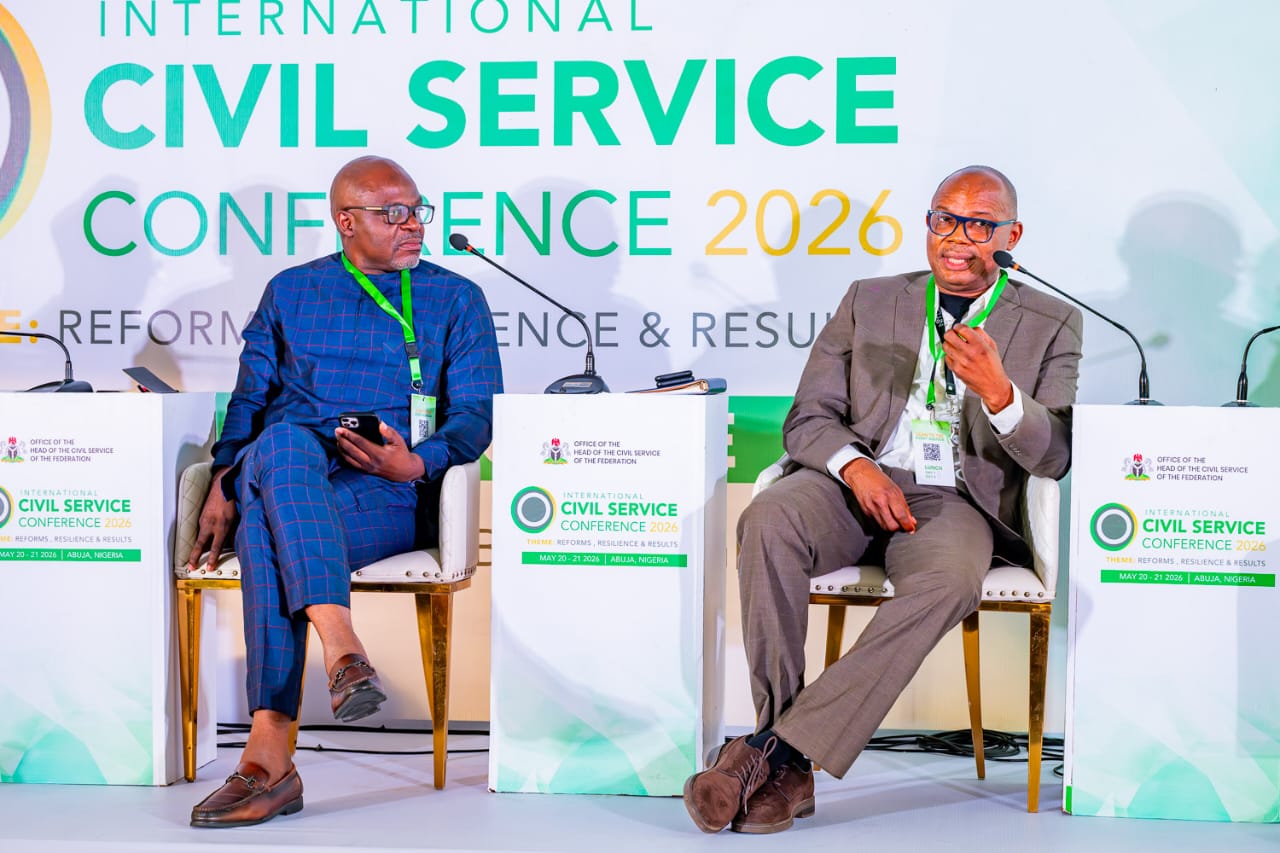
ABUJA, NIGERIA — The Director General of the National Information Technology Development Agency (NITDA), Kashifu Inuwa CCIE, has urged public institutions to responsibly embrace Artificial Intelligence (AI) by prioritizing human accountability, robust policy frameworks, and digital skills development. Speaking at the International Civil Service Conference 2026 at Eagle Square in Abuja, Inuwa—who was represented by NITDA’s Director of Stakeholder Management and Partnership, Dr. Aristotle Onumo—disclosed that the agency has already launched a comprehensive AI Transformation Plan. This three-year initiative is designed to future-proof the organization, ensuring seamless institutional efficiency, continuity, and productivity regardless of personnel changes. As part of this blueprint, the agency has fully integrated AI into its internal workflows, transforming routine operations like document management and task tracking. Official correspondence submitted at the agency’s headquarters is now scanned immediately at the security gate and automatically routed to the appropriate officers using AI-driven keyword recognition. Furthermore, the automated infrastructure actively monitors task timelines, flagging delays and generating reports if an official fails to attend to documentation within the stipulated timeframe. Addressing widespread anxieties regarding job displacement within the public sector, the NITDA boss clarified that AI should be viewed as an efficiency-boosting tool rather than a threat to human relevance. He noted that while workers who refuse to adapt or upskill may find their roles at risk, those willing to retrain will find immense value in the technology. He emphasized that the evolution of the workplace demands a mindset shift toward continuous learning to remain competitive in a rapidly changing digital economy. To smoothly transition its workforce into this new era, NITDA has commenced agency-wide AI capacity-building programmes for all staff members. Rather than laying off employees whose traditional roles have been automated, the agency is actively retraining and redesigning their positions into emerging tech functions. For instance, personnel who previously managed manual filing systems have now been upskilled and redesignated as AI assistants and AI administrators, effectively preparing the internal workforce for the future. Despite these advancements, Inuwa strongly cautioned against removing human oversight from governance systems, stressing that ultimate accountability must always rest with a human being. He called on all Ministries, Departments, and Agencies (MDAs) to formulate internal AI policies that establish clear operational boundaries. He noted that public sector deployment differs significantly from the private sector, as government institutions must bear full responsibility for any algorithmic failures or ethical breaches. The Director General also highlighted the critical need for robust governance frameworks that align with data protection regulations to protect citizens’ rights and prevent data misuse. He revealed that NITDA is currently using its own internal operations as a practical sandbox to test AI implementation models before they are scaled across the wider public service ecosystem. This effort builds upon the foundation of Nigeria’s National AI Strategy, which stands as one of the country’s most forward-looking digital policy documents. In concluding his remarks, Inuwa disclosed that NITDA is collaborating directly with the Office of the Head of Civil Service of the Federation to equip civil servants nationwide with digital literacy and AI competencies. He reiterated that while artificial intelligence will not entirely replace the workforce, adaptability is no longer optional. Through strategic partnerships and continuous learning, Nigeria’s public sector can successfully leverage emerging technologies to drive inclusive growth and effective governance.


Leave a Reply