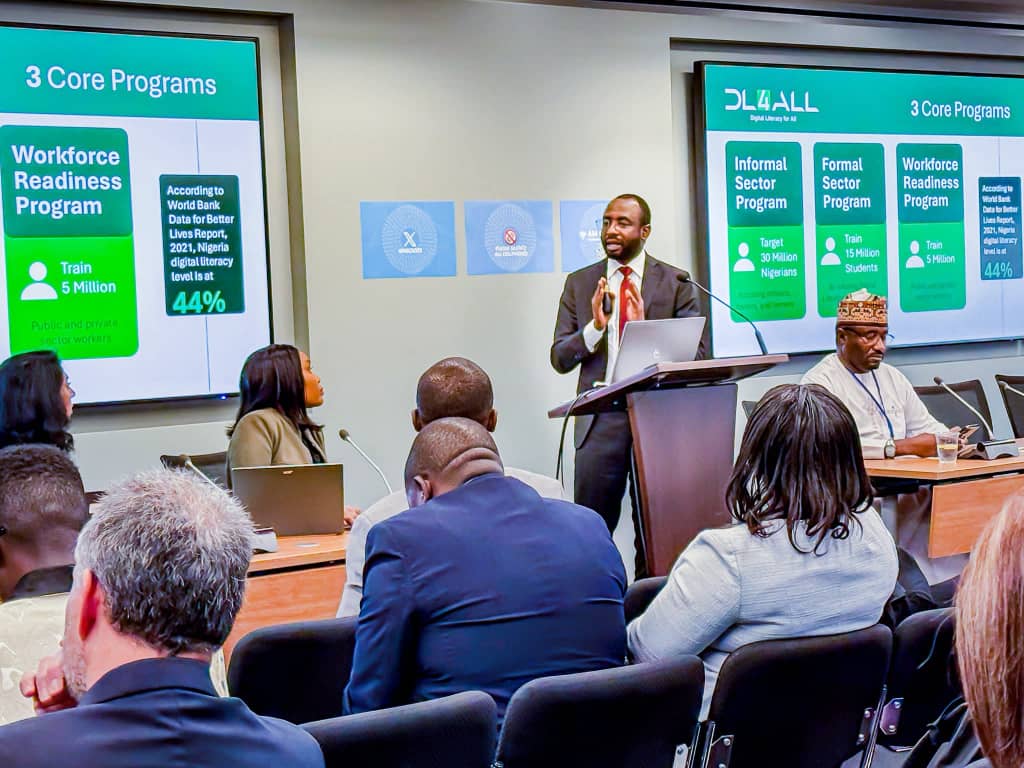
Digital innovation and renewable energy are essential for boosting inclusive growth and improving rural communities in Nigeria, according to Kashifu Inuwa, CCIE, Director General of the National Information Technology Development Agency (NITDA). At the 2025 Annual Meetings of the World Bank Group and International Monetary Fund (IMF) in Washington, D.C., Inuwa was a panelist at the Civil Society Policy Forum. She referred to renewable energy as a “fundamental enabler” for economic empowerment and digital inclusion. ”The goal is not renewable energy. Power acts as a catalyst, causing connectivity, which in turn leads to real transformation, he stated. Using examples of AI-powered farming tools, online platforms for female entrepreneurs, and remote digital jobs that enable young people to earn globally while residing locally, Inuwa demonstrated how access to clean energy and technology can revolutionize rural livelihoods. ”With just a basic app, a farmer can send his child to school, double his income, and hire people.” A young person with internet access doesn’t need to migrate to Abuja or Lagos he can work from his village and earn in dollars,” he noted. The head of NITDA connected these programs to the Renewed Hope Agenda of President Bola Ahmed Tinubu, which places a high priority on inclusivity, diversity, and sustainability. He clarified that NITDA’s operational framework builds upon eight strategic pillars, including digital literacy, research, cybersecurity, innovation, and strategic partnerships, while Nigeria’s digital economy strategy, which is overseen by the Ministry of Communications, Innovation, and Digital Economy, is based on five major pillars: knowledge, policy, infrastructure, innovation and entrepreneurship, and trade. According to Inuwa, NITDA is working with the Federal Ministry of Education to incorporate digital literacy into the curriculum of Nigerian schools at all educational levels, from kindergarten to university. Additionally, in the civil service, digital competency is now required for both employment and advancement. By 2027, the organization hopes to have trained 50 million Nigerians through these programs, producing a workforce with the necessary skills to spearhead the country’s digital transformation. “Our vision is clear, our journey is set, and our resolve is stronger than ever. We encourage everyone to work with us to create a prosperous and digitally empowered Nigeria,” Inuwa said. The World Bank Group’s Senior Operations Officer for Infrastructure, Fowzia Hassan, also spoke during the session and reiterated the Bank’s commitment to extending energy access throughout Africa through its ambitious Mission 300 (M300) initiative, which aims to add 300 million new connections by 2030. Although the Bank’s development agenda has always placed a high priority on energy access, Hassan stated that with M300, “we have set a clear target, a deadline, and the resources to make it happen.” According to her, the initiative combines the World Bank, IFC, and MIGA’s efforts to improve regulations, draw in private capital, and use cutting-edge financing techniques like risk-sharing facilities and blended finance to reach marginalized communities. Hassan brought attention to the gender aspect of energy access by quoting data from the International Renewable Energy Agency (IRENA) that indicates women comprise 32% of Africa’s workforce in renewable energy, primarily in non-technical positions. She called for deliberate policies to enhance women’s participation in technical and leadership positions. “Women are vital consumers, producers, and decision makers in energy. However, she emphasized, “they face challenges in the areas of education, employment, and finances.” The DAIRS program in Nigeria, which aims to raise over $1 billion for mini grids and solar systems, partnerships with the African Development Bank (AfDB) on National Energy Compacts, and the Women in Energy Network Africa (WEN-Africa), which has already helped 57 women find employment and has set a target of 4,000 jobs for women in the energy sector within three years, are some of the major World Bank-supported projects, Hassan continued. ”Building a clean, inclusive, and just energy transition is about empowering people, especially women and youth, to drive Africa’s prosperity, not just about connecting homes,” she stated.


Leave a Reply