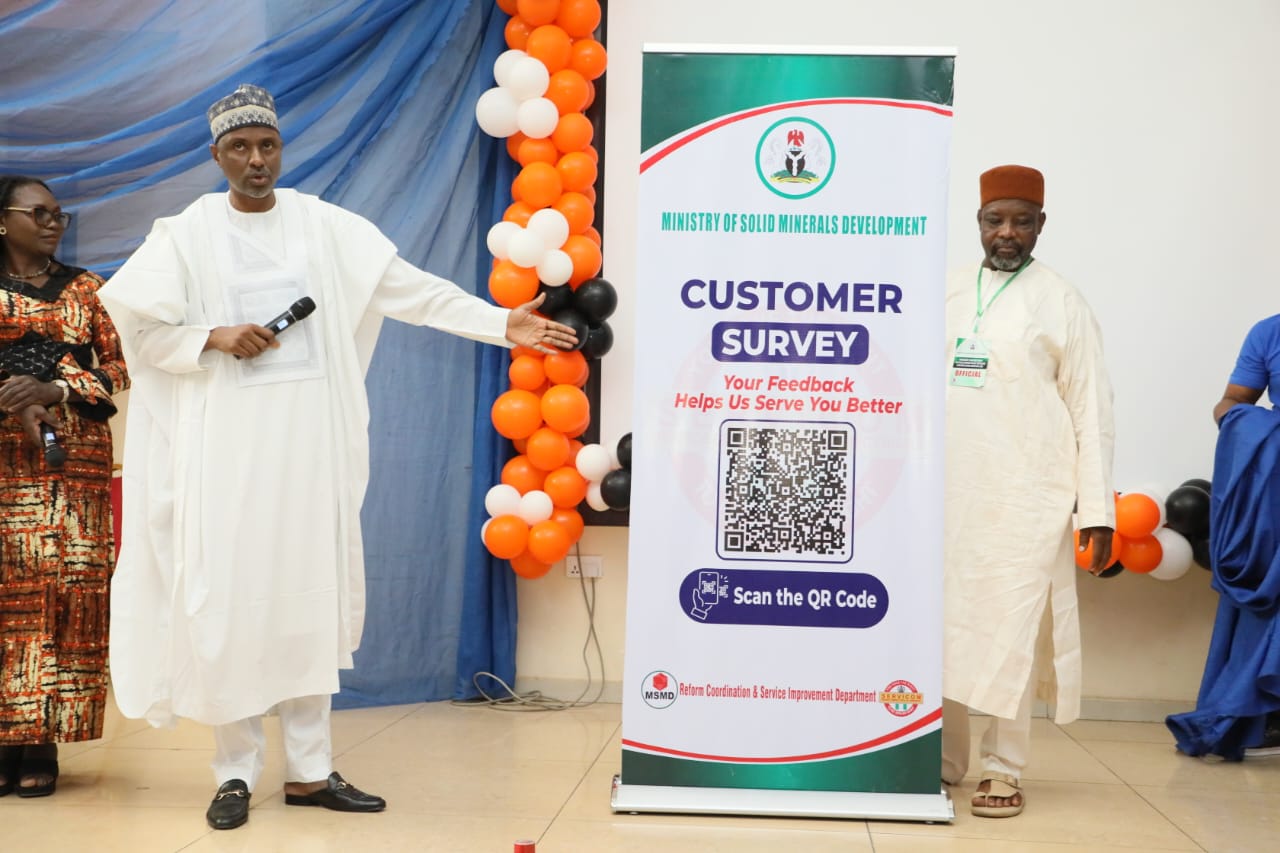
The Ministry of Solid Minerals Development has unveiled a digital access code to enable mining operators and host communities to communicate directly with the ministry’s leadership and report challenges affecting their operations. The Minister of Solid Minerals Development, Dr Dele Alake, disclosed this on Thursday in Abuja while declaring open the ministry’s Stakeholders’ Engagement Session with Mining Operators and Host Communities in the North-Central geopolitical zone. Alake, who was represented by the Permanent Secretary, Engr Faruk Yusuf Yabo, said the initiative was part of efforts to improve service delivery, strengthen transparency and make the ministry more accessible and responsive to stakeholders’ concerns. He explained that the QR code would provide direct access to the minister, permanent secretary and directors of the ministry, allowing stakeholders to submit complaints, observations and other concerns without necessarily visiting the ministry’s offices. According to him, the initiative reflects the ministry’s commitment to ensuring that stakeholders can easily reach relevant officials whenever they encounter challenges in their dealings with the ministry. ”The idea of service is to give access. If we are providing service and you can’t access us, then we are not really delivering service,” he said. He added that the initiative was part of the ministry’s ongoing digitisation of its processes, noting that several licensing procedures had already been moved online to reduce the need for physical visits and improve administrative efficiency. Alake cited the electronic processing of permits, including permits for the purchase of explosives, as an example of the ministry’s efforts to simplify regulatory procedures and improve access to its services. He said the engagement would also provide an opportunity for the ministry to receive feedback on areas requiring improvement, stressing that effective service delivery could only be achieved through continuous interaction with those who depend on its services. The minister said the Federal Government remained committed to repositioning the solid minerals sector as a major contributor to economic diversification, industrial development, employment generation and national prosperity. He noted that achieving these objectives required sustained collaboration among government institutions, investors, mining operators, community leaders and other relevant stakeholders. According to him, the theme of the 2026 Customer Service Week, “The Extra Mile,” underscores the importance of government institutions going beyond routine administrative responsibilities by listening to stakeholders, addressing legitimate concerns and creating an enabling environment for investment and sustainable development. He said the ministry’s seven-point agenda provided strategic direction for developing the sector, but its successful implementation depended on effective regulation, responsible mining practices, improved investment, regulatory compliance, value addition, community participation and strong institutional coordination. Alake emphasised that mining operators had a responsibility to comply with applicable laws and regulations, conduct their activities responsibly and maintain constructive relationships with their host communities. He also described host communities as important partners in the development of the sector, saying their concerns, particularly regarding environmental protection, community benefits, local participation and the social impact of mining activities, must receive adequate attention. The minister acknowledged the need to address administrative bottlenecks, improve regulatory processes, strengthen transparency and ensure that legitimate concerns raised by stakeholders received timely attention. He urged participants to openly present their observations, experiences and recommendations, noting that the objective of the engagement was not merely to identify challenges but also to develop practical solutions, strengthen accountability and establish clear areas of collaboration and follow-up. He assured stakeholders that the ministry remained committed to building a transparent, competitive, responsible and sustainable solid minerals sector that would benefit all Nigerians. Alake also expressed appreciation to the ministry’s management, the Reform Coordination and Service Improvement team, the SERVICOM Presidency and other participants for their contributions towards improving service delivery in the sector. He formally declared the engagement open, expressing optimism that discussions would produce meaningful recommendations and actionable outcomes. Earlier, the Permanent Secretary of the ministry, Engr Faruk Yusuf Yabo, represented by the Head of Department of Reform Coordination and Service Improvement, Mr Salisu Attah, said the engagement was organised to strengthen coordination and collaboration between the ministry and stakeholders in the solid minerals sector. He explained that the meeting was designed to obtain direct feedback on challenges confronting the industry, particularly those relating to regulation, institutional processes and customer engagement. Attah said the engagement would also improve stakeholders’ understanding of the ministry’s regulatory mandate, policy priorities and the minister’s agenda, while providing mining operators and other participants with an opportunity to present their experiences and recommendations. He identified other objectives of the meeting as examining existing challenges and administrative bottlenecks, identifying opportunities for improvement, strengthening mutual understanding and agreeing on action points for effective follow-up. He urged participants to make their contributions clear, specific and solution-oriented, stressing that the meeting was not intended to be a mere presentation but an opportunity for genuine interaction and constructive feedback. The ministry, he said, remained committed to listening to stakeholders and working towards a more efficient, transparent and responsive solid minerals sector. Providing further clarification on the objectives of the engagement, Attah said it was also aimed at preventing future disagreements between the ministry and stakeholders by promoting collaboration, transparency and mutual understanding. He added that the meeting would enable participants to make recommendations and agree on action points that would guide appropriate follow-up. Speaking on the unveiling of the QR code, the representative of the Acting National Coordinator of SERVICOM, Presidency, Lucy Zach-Ukoh Team Lead, SERVICOM Office, Presidency, said, customers and key stakeholders remained central to the ministry’s existence and service delivery responsibilities. She noted that although the ministry provided services, stakeholders were in the best position to assess the quality of those services based on their experiences. According to her, the introduction of the QR code would make it easier and faster for stakeholders to provide feedback and enable the ministry to respond to their concerns more effectively. She encouraged participants to take advantage of the platform, describing feedback as an important instrument for improving institutional performance and ensuring that public services meet the expectations of their beneficiaries.


Leave a Reply