

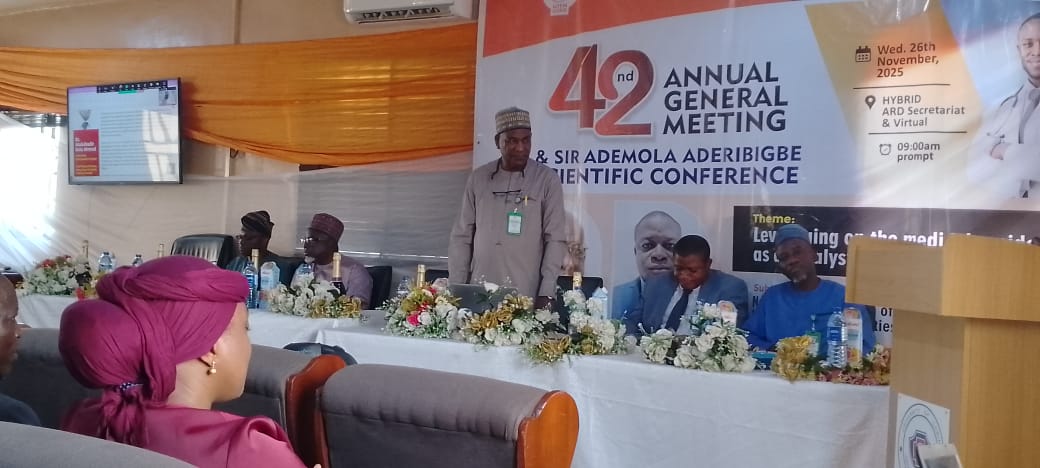
The Chief Medical Director (CMD) of the Kwara State University Teaching Hospital (KWASUTH), Dr. Abdulkadir Ahmed, has raised concern over Nigeria’s poor funding of its health sector, describing the country’s health budget as one of the lowest in Africa.
Dr. Ahmed made the observation in Ilorin while delivering a paper at the 42nd Annual General Meeting and Sir Ademola Aderibigbe Scientific Conference of the Association of Resident Doctors, University of Ilorin Teaching Hospital (ARD-UITH). The theme of this year’s conference is “Leveraging on the Medical Residency Training as a Catalyst for Healthcare Reforms in Nigeria.”
The CMD, who is also a Consultant Orthopaedic Surgeon, lamented that Nigeria has yet to align with the Abuja Declaration, which recommends that at least 15 percent of a nation’s annual budget should be allocated to the health sector.
“Nigeria’s healthcare financing is low even when compared to other African countries. It is one of the countries that spends the least per individual on healthcare in the world,” he stated.
According to him, Nigeria spent only 0.5 percent of its GDP on health in 2019, while government expenditure on health in 2020 accounted for just 4.2 percent of the national budget.
Dr. Ahmed explained that the chronic underfunding of the health sector has resulted in numerous challenges, including poor infrastructure, inadequate facilities, and a weak health system. Citing the World Health Organisation (WHO), he noted that Nigeria currently ranks 187th out of 191 countries in global health system performance.
He also warned that with Nigeria’s population projected to hit 433 million — and possibly 700 million — by 2100, the country risks an overstretched health system if urgent measures are not taken.
Dr. Ahmed appealed to government at all levels to increase investment in healthcare, particularly in manpower development, infrastructure, and strengthening health services in rural communities. He urged resident doctors to equip themselves with leadership and management skills, noting that strong clinical leadership is essential for improving healthcare delivery.
In his remarks, the Permanent Secretary of the Kwara State Ministry of Health, Dr. Taoheed Abdullahi, described the conference theme as timely, stressing that it aligns with the country’s health sector transformation agenda. He reaffirmed the state government’s commitment to supporting resident doctors and improving their training environment.
Dr. Abdullahi also urged young doctors to remain dedicated, saying the country needs their expertise at this crucial time to revive the “near-collapsed” health sector.
Earlier, President of ARD-UITH, Dr. Monsuru Awodun, highlighted the association’s developmental strides, including the completion of phase two of the ARD-UITH lodge and the renovation of three doctors’ call rooms to enhance working conditions. He, however, lamented the numerous challenges confronting resident doctors but maintained that they remain committed to their oath to save lives.
Leave a Reply